
Key Takeaways
- Carpenter ants are one of the most destructive pests in Calgary homes — they don’t eat wood, but they tunnel through it, causing structural damage that can cost thousands to repair (Source)
- Calgary’s older housing stock, long winters, and spring moisture create ideal conditions for carpenter ant infestations — especially in homes with damp basements or wooden decks
- Signs include piles of coarse sawdust (frass), rustling sounds in walls at night, and large black ants indoors — especially in spring when swarmers emerge
- DIY sprays and store-bought baits rarely eliminate the colony — professional nest location and targeted treatment is the only reliable way to remove carpenter ants for good (Source)
- Spring is the best time to inspect, prevent, and treat carpenter ants — before colonies expand and satellite nests form
If you have seen large black ants marching across your kitchen floor or noticed piles of sawdust-like material near your baseboards, you may be dealing with carpenter ants — one of the most damaging pests an Calgary home can face. Unlike termites (which are rare in Alberta), carpenter ants are common across the Calgary area, and they can quietly cause serious structural damage before you even realize they are there.
This guide covers everything Calgary homeowners need to know about carpenter ants: how to spot them, why they target your home, how to prevent infestations, and when to call a professional exterminator.
What Are Carpenter Ants and Why Do Calgary Homes Attract Them?
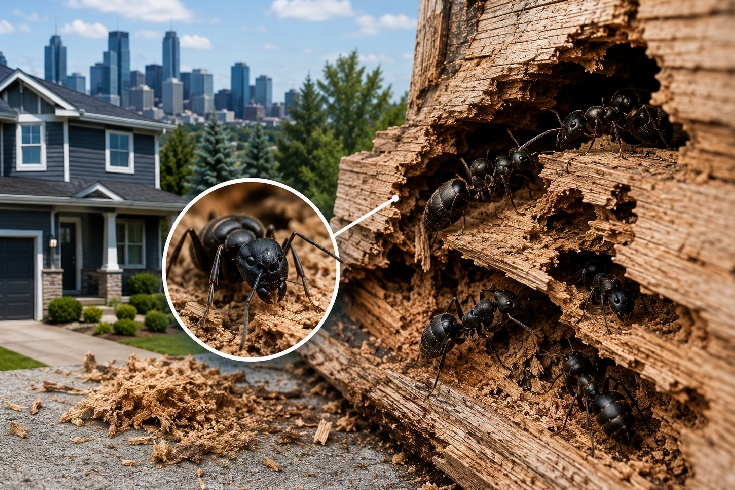
Carpenter ants (Camponotus species) are large ants that range from 6 to 13 mm in length. They are typically black or bicoloured (black and reddish-brown). Unlike termites, carpenter ants do not eat wood — they excavate it to create smooth tunnels and galleries for their nests.
Calgary homes are particularly vulnerable to carpenter ants for several reasons:
- Older housing stock — Many Calgary neighbourhoods have homes built in the 1950s-1970s with aged, moisture-prone wood
- Wooden construction — Wood siding, decks, fences, and sill plates provide ideal nesting sites when combined with moisture
- Long winters with snowmelt — Freeze-thaw cycles create gaps and cracks while spring snowmelt keeps wood damp
- Basement moisture — Calgary’s clay soils can lead to foundation moisture issues that attract carpenter ants
- Firewood storage — Many Calgary homeowners store firewood against the house, creating a direct bridge for ants
If you have seen other types of ants in your Calgary home, read our guide to common Calgary pests for identification help.
How to Tell If You Have Carpenter Ants — Not Regular Ants
This is the most common mistake Calgary homeowners make. Regular pavement ants or pharaoh ants are small and do not damage wood. Carpenter ants are different:
- Size — Carpenter ants are noticeably larger (6-13 mm). Large ants = likely carpenter ants
- Frass (sawdust) — Coarse sawdust-like material near baseboards is the #1 sign of carpenter ants. It looks like pencil shavings mixed with fine sand and often contains insect body parts
- Timing — You are most likely to see them indoors during spring (March-May) when swarmers emerge to start new colonies
- Noise — Faint rustling sounds inside walls or ceilings at night is the sound of carpenter ants excavating wood
- Winged ants indoors — If you see large winged ants inside your home in spring, you likely have an established nest in the structure
The Damage Carpenter Ants Can Cause to Your Calgary Home
Carpenter ants do not destroy wood as quickly as termites. But over several years, an untreated colony can cause significant structural damage. The tunnels weaken wooden beams, joists, sill plates, and wall studs. In severe cases, homeowners have had to replace entire sections of framing — a cost that can run into tens of thousands of dollars.
The City of Calgary recognizes carpenter ants as a significant residential pest issue (City of Edmonton Pest Info). The damage is often hidden inside walls, attics, or crawlspaces, which is why early detection and professional treatment is so important.
Where Carpenter Ants Nest in Calgary Homes
Carpenter ant colonies have a parent nest (usually outdoors in a tree stump, wood pile, or damp log) and one or more satellite nests inside the structure. Common locations include:
- Sill plates and rim joists — The wood that sits on the foundation. Dampness from concrete creates ideal nesting conditions
- Attics and roof eaves — Leaky roofs or poor ventilation create damp wood
- Around windows and doors — Leaky window frames and weather-damaged exterior trim
- Decks and porches — Wooden decks in contact with the ground or with moisture damage
- Basements and crawlspaces — Damp wood around sump pumps, water heaters, and foundation cracks
- Firewood piles and landscape timbers — Firewood stored against the house creates a bridge for ants
Spring Prevention Checklist for Calgary Homeowners
The best way to avoid carpenter ant problems is to prevent them before spring activity begins:
Exterior Inspection
- Walk around your foundation and seal cracks, gaps, and holes larger than a dime
- Check eaves, soffits, and fascia for water damage or rotting wood — replace damaged sections
- Ensure downspouts drain at least 1.5 metres away from your foundation
- Remove firewood and lumber from against the house. Store wood at least 6 metres from the foundation and off the ground
- Trim tree branches and shrubs that touch your roof or siding
Interior Inspection
- Check basements for damp wood, water stains, or known leak areas
- Seal gaps around pipes, electrical conduits, and HVAC lines entering the house
- Inspect window frames and door frames for rot or damage
- Use a flashlight at night to check for ant trails along baseboards and in utility rooms
- Listen for rustling sounds in walls — especially at night
For general year-round prevention, see our Integrated Pest Management guide for Calgary homes.
Why DIY Carpenter Ant Control Usually Fails in Calgary
Most Calgary homeowners try the hardware store route first. But ant sprays, baits, and powders rarely solve the problem:
- Sprays kill foragers, not the colony — The parent nest and queen remain untouched
- Baits can be ineffective — Carpenter ant workers do not always carry bait back to the nest
- Nests are hidden — Parent nests are often outside while satellite nests are inside walls. DIY treatments cannot reach both
As our guide to professional vs DIY pest control explains, carpenter ants require professional expertise.
What Professional Carpenter Ant Treatment Looks Like in Calgary
Step 1 — Inspection: A technician inspects the property for trails, frass, moisture damage, and potential nesting sites.
Step 2 — Nest Location: The technician traces ant trails back to the source — parent nests in tree stumps or logs, satellite nests in walls or attic spaces.
Step 3 — Treatment: Targeted dust formulations are applied directly into nest voids. Exterior perimeter treatment prevents reinfestation.
Step 4 — Prevention: The technician recommends moisture repairs and sealing points. A follow-up visit confirms elimination.
When Is Carpenter Ant Season in Calgary?
- Spring (March-May): Swarmers emerge to start new colonies. Critical window for prevention
- Summer (June-August): Peak colony activity. Trails visible at night
- Fall (September-October): Activity slows but indoor sightings may increase
- Winter (November-February): Colonies are dormant, but heated indoor nests can stay active
Spring 2026 is expected to bring higher carpenter ant pressure across Alberta. See Calgray pest control trends 2026 for more.
How Much Does Carpenter Ant Treatment Cost in Calgary?
- Basic inspection and treatment (single nest): $250-$450
- Moderate infestation (multiple satellite nests): $450-$800
- Severe infestation with structural damage: $800-$1,500+ plus repairs
Most Calgary companies include a warranty. Compare with our 2026 Calgary pest control pricing guide.
When to Call an Calgary Carpenter Ant Exterminator
- Large ants (6 mm or larger) inside your home, especially in spring
- Piles of coarse sawdust near baseboards or windows
- Winged ants indoors — almost always means an established nest
- Rustling sounds in walls or ceilings at night
- Previous DIY treatments have failed
- You have moisture damage or rotting wood
If you are unsure, contact an Calgary exterminator for an inspection. The cost is minor compared to structural repairs from an untreated infestation.
Conclusion
Carpenter ants are a serious threat to Calgary homes, but they are preventable and treatable when caught early. Spring is the most important time to inspect your property, seal entry points, and address moisture problems.
At Calgary Pest Control, our technicians are trained to locate both parent and satellite nests and eliminate colonies completely. Contact us today for a free inspection and quote.